
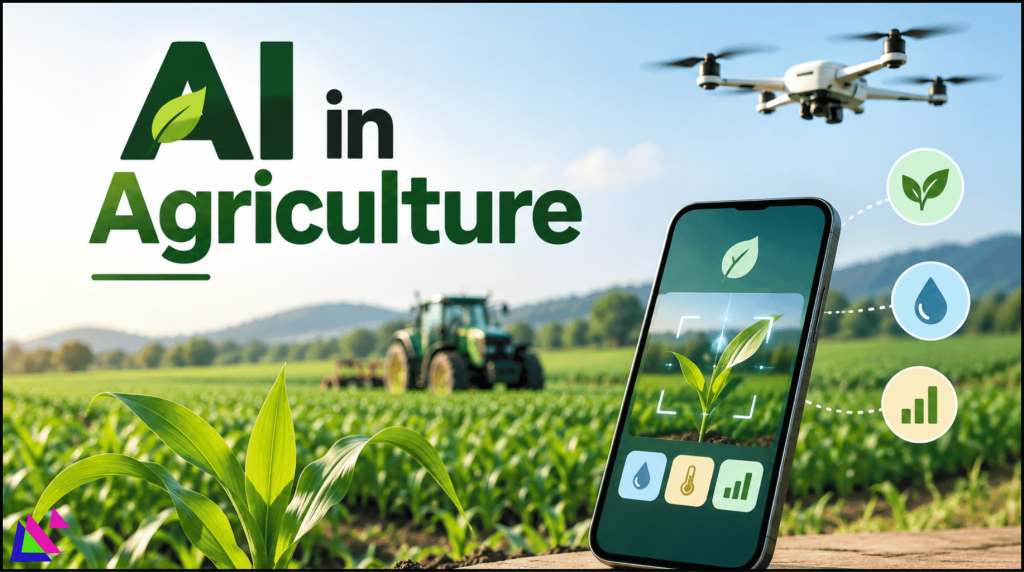
AI in Agriculture is becoming an important part of modern farming as technology helps farmers make better decisions about crops, weather, soil, pests, and markets. Instead of relying only on traditional experience, farmers can increasingly combine that knowledge with data and digital tools.
India is also moving in this direction. The government-backed Bharat-VISTAAR platform is designed as an AI-driven digital public infrastructure for agriculture, offering services such as crop and livestock advisories, weather information, mandi prices, soil advice, and pest and disease guidance.
How Is AI Being Used in Agriculture?
AI can process different types of information and turn them into useful recommendations.
Farmers can benefit from AI for:
- Weather information.
- Crop planning.
- Pest detection.
- Disease alerts.
- Soil advice.
- Market prices.
- Irrigation decisions.
- Farm management.
This can help farmers make decisions based on current information instead of depending only on fixed schedules.
Weather and Crop Decisions
Weather plays a major role in farming.Heavy rain, drought, heat, and changing weather patterns can affect crops significantly.AI systems can combine weather information with other agricultural data to provide more useful guidance.
For example, farmers may use technology to understand:
- When rain is expected.
- Whether irrigation may be needed.
- When certain farming activities should happen.
- Whether weather conditions could increase crop risks.
However, AI predictions should support local farming knowledge rather than replace it.
Pest and Disease Detection & Soil and Irrigation
Crop diseases and pests can cause serious losses if farmers identify them too late.AI tools can analyze images and agricultural information to help identify possible problems.
This can help farmers:
- Detect symptoms earlier.
- Identify possible pests.
- Get treatment guidance.
- Reduce unnecessary chemical use.
- Monitor crop health.
The accuracy of such tools depends on the quality of data, images, local conditions, and the specific crop.
Soil and Irrigation
Soil conditions can vary greatly between farms.AI-based systems can combine soil information with weather and crop data to provide more targeted recommendations.
Possible benefits include:
- Better irrigation planning.
- More efficient fertilizer use.
- Improved crop planning.
- Reduced resource waste.
This can become particularly useful when farmers have access to reliable local data.
Market Information
- Farmers also need information after producing a crop.
- Market prices can influence where and when farmers sell their products.
- Digital agriculture platforms can bring information such as mandi prices closer to farmers.
- Bharat-VISTAAR, for example, includes access to mandi prices from Agmarknet along with weather, soil, crop, and pest-related services.
Pros of AI in Agriculture
1. Better Decisions: Farmers can use more information when planning farming activities.
2. Early Warnings: AI tools can help identify potential weather, pest, or disease risks.
3. Resource Efficiency: Better recommendations may help farmers use water, fertilizers, and other resources more carefully.
4. Faster Information: Farmers can access several types of information through digital platforms.
5. Wider Access: Voice-based and multilingual systems can make technology easier to use for farmers who are less comfortable with complex apps.
Cons and Challenges
1. Internet and Device Access: Not every farmer has reliable connectivity or suitable devices.
2. Data Quality: Poor or incomplete data can lead to poor recommendations.
3. Digital Skills: Farmers may need support to understand and use new tools.
4. Local Differences: A recommendation that works in one region may not work equally well somewhere else.
5. Trust: Farmers need to understand where recommendations come from before making important decisions based on them.
Why Local Languages Matter
Technology becomes more useful when people can access it in a language they understand comfortably.This is particularly important in agriculture because farmers across India use many different languages.Voice-based systems can also help people who may find typing difficult.The Bharat-VISTAAR initiative is designed to provide farmer-focused digital agricultural services through an AI-driven ecosystem.
What Does AI Mean for Small Farmers?
AI should not be limited to large commercial farms.
Small farmers can also benefit from simple services such as:
- Weather alerts.
- Crop advice.
- Pest information.
- Market prices.
- Soil guidance.
- Government scheme information.
The key is making these services affordable, accessible, local, and easy to understand.
The Future of AI in Agriculture
AI in Agriculture could become more useful as satellite data, sensors, weather information, farm records, and local knowledge become better connected.Future systems may provide more personalized recommendations for individual farms.However, AI should work alongside farmers rather than replace them.Farmers understand their land, crops, and local conditions in ways that a general AI system may not fully capture.
Conclusion
AI in Agriculture is changing how farmers can access and use information. From weather and soil advice to pest alerts and market prices, AI can help turn large amounts of data into practical guidance.
India’s Bharat-VISTAAR initiative shows how the country is trying to build a larger digital agriculture ecosystem around these technologies.
The biggest opportunity is not simply putting AI into farming. It is making sure farmers can actually use the technology, understand its recommendations, and combine them with their own experience.
FAQs
1. What is AI in Agriculture?
Ans: It means using artificial intelligence and related technologies to support farming decisions, crop management, weather analysis, pest detection, and other agricultural activities.
2. How can AI help farmers?
Ans: AI can provide information about weather, crops, soil, pests, diseases, and market conditions.
3. Can AI replace farmers?
Ans: No. AI can provide recommendations, but farmers still make decisions using their experience and knowledge of local conditions.
4. What is Bharat-VISTAAR?
Ans: Bharat-VISTAAR is an AI-driven digital public infrastructure initiative designed to provide farmers with integrated agricultural information and advisory services.
5. What are the biggest challenges of AI in agriculture?
Ans: Connectivity, device access, data quality, digital skills, local accuracy, and user trust are some of the major challenges.

Hi, I’m Dev Kirtonia, Founder & CEO of Dev Library. A website that provides all SCERT, NCERT 3 to 12, and BA, B.com, B.Sc, and Computer Science with Post Graduate Notes & Suggestions, Novel, eBooks, Biography, Quotes, Study Materials, and more.







 Buy Now