
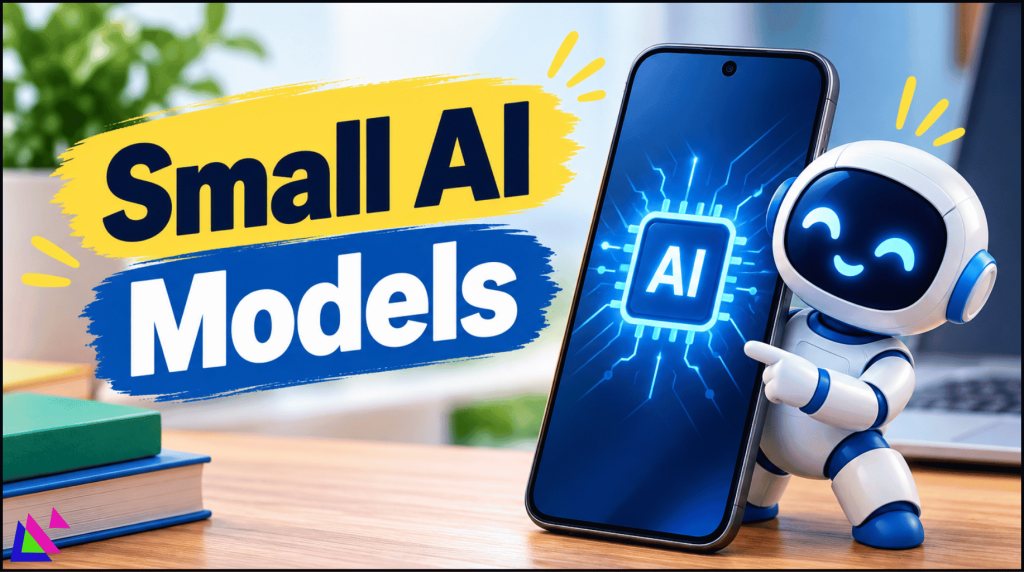
Small AI Models are changing the way people think about artificial intelligence. Until recently, powerful AI models usually depended on cloud servers and an internet connection. Now, newer compact models are showing that useful AI can also run directly on smartphones and other personal devices.
A notable example is Bonsai 27B, a 27-billion-parameter model developed by PrismML that has been compressed enough to run on a smartphone. The company says its 1-bit version uses about 3.9 GB of storage and can run locally on supported phones.
This development could make AI more private, portable, and available even when users have limited internet access.
What Are Small AI Models?
Small AI models are AI systems designed to use fewer computing resources than very large models.
They can offer:
- Lower memory requirements.
- Faster responses on suitable devices.
- Lower infrastructure needs.
- More local processing.
- Easier deployment on phones and laptops.
However, “small” does not necessarily mean “weak.” Better model compression and optimization can allow smaller models to perform useful tasks while using much less hardware.
How Can AI Run on a Phone?
Normally, when someone asks an AI assistant a question, the request travels to a remote data center. The server processes it and sends the answer back.
With local AI, the processing happens directly on the device.
The basic process is:
User request → Phone processes the model → AI generates responseThis approach reduces the need to constantly send information to a cloud server.
Why Is This Important?
The move toward local AI could change how people use AI in everyday life.
1. Better Privacy: Some information can stay on the device instead of being sent to a remote server.
2. Less Dependence on the Internet: A locally running model can continue working when connectivity is limited, depending on the application.
3. Faster Response: Removing the network trip can reduce some types of delay.
4. More Personal AI: Developers could build AI features that work directly inside mobile applications.
5. Lower Cloud Dependence: Businesses may reduce some cloud-processing requirements for suitable workloads.
What Is Bonsai 27B?
Bonsai 27B is an example of how model compression can bring larger AI capabilities to smaller devices.PrismML describes it as a 27B-class model capable of running on a phone, with 1-bit and ternary versions available. Its 1-bit version is listed at around 3.9 GB.The model is based on a compressed version of Qwen3.6-27B, according to reports about its release. This does not mean every smartphone can run it smoothly. Device memory, processor capability, and software support still matter.
Pros of Small AI Models
1. Privacy: Local processing can keep certain information on the device.
2. Portability: Users can carry AI capabilities with them without relying completely on cloud services.
3. Lower Cloud Usage: Some tasks can run locally rather than using remote computing resources.
4. Offline Potential: Suitable applications can continue working without a constant connection.
5. More Developer Freedom: Developers can create AI features directly inside mobile applications.
Cons of Small AI Models
1. Limited Performance: Smaller models may not match the capabilities of the largest cloud-based models on every task.
2. Hardware Requirements: A model may be technically small but still require a phone with enough RAM and processing power.
3. Battery Usage: Running AI locally can consume significant device resources.
4. Heat: Long AI workloads can put additional pressure on a phone’s processor.
5. Model Updates: Cloud services can update their models centrally, while local models may require users or developers to install new versions.
Where Could Local AI Be Used?
Small AI Models could become useful in several areas:
- Personal assistants.
- Translation.
- Note-taking.
- Education apps.
- Writing tools.
- Camera applications.
- Accessibility features.
- Offline productivity tools.
- Mobile coding assistants.
For example, a student could use a local AI tool to summarize notes without sending those documents to an external server.
What Does This Mean for Smartphones?
Smartphones may increasingly become AI computing devices rather than simply screens connected to cloud services.
Manufacturers could use local AI for:
- Camera enhancement.
- Voice features.
- Personal recommendations.
- Document processing.
- Translation.
- Accessibility.
This could make AI features more responsive and useful while reducing dependence on remote servers for certain tasks.
The Future of Small AI Models
Small AI Models are unlikely to replace the largest AI systems completely. Instead, both approaches could work together.Cloud models can handle demanding tasks, while local models can manage simpler or privacy-sensitive activities.This could create a hybrid system where the device decides which tasks should stay local and which require cloud computing.
Conclusion
Small AI Models are opening an interesting new direction for AI. Bonsai 27B shows that a model with billions of parameters can be compressed enough to run on a smartphone, although device requirements and performance still vary.
The bigger change is that AI may no longer need to live only inside large data centers. Some useful AI capabilities could increasingly sit directly in our phones, laptops, cars, and other devices.That could make AI more private, accessible, and available wherever people need it.
FAQs
1. What are small AI models?
Ans: They are AI models designed to use less memory and computing power while still providing useful capabilities.
2. Can AI models really run on smartphones?
Ans: Yes. Models such as Bonsai 27B have been designed to run locally on supported smartphones.
3. Is local AI better than cloud AI?
Ans: Neither is always better. Local AI can offer privacy and offline benefits, while cloud AI can provide greater computing power.
4. Does running AI on a phone require powerful hardware?
Ans: Usually, yes. RAM, processor capability, storage, and software support can affect performance.
5. Will smartphones use more local AI in the future?
Ans: Local AI is likely to become more common as models become smaller and mobile hardware becomes more capable.

Hi, I’m Dev Kirtonia, Founder & CEO of Dev Library. A website that provides all SCERT, NCERT 3 to 12, and BA, B.com, B.Sc, and Computer Science with Post Graduate Notes & Suggestions, Novel, eBooks, Biography, Quotes, Study Materials, and more.






 Buy Now