
AI in Road Maintenance is giving cities a new way to identify damaged roads. Instead of relying entirely on manual inspections, researchers and engineers are developing systems that use cameras, GPS data and AI vision models to detect potholes, cracks and other road problems.
A recent example comes from Bengaluru, where engineer Gaurav Sen developed an AI-powered system that uses dashcam footage, GPS, an accelerometer and computer vision to detect potholes and identify the authority or contractor responsible for the road.This approach could make road monitoring faster and create better records for maintenance work.
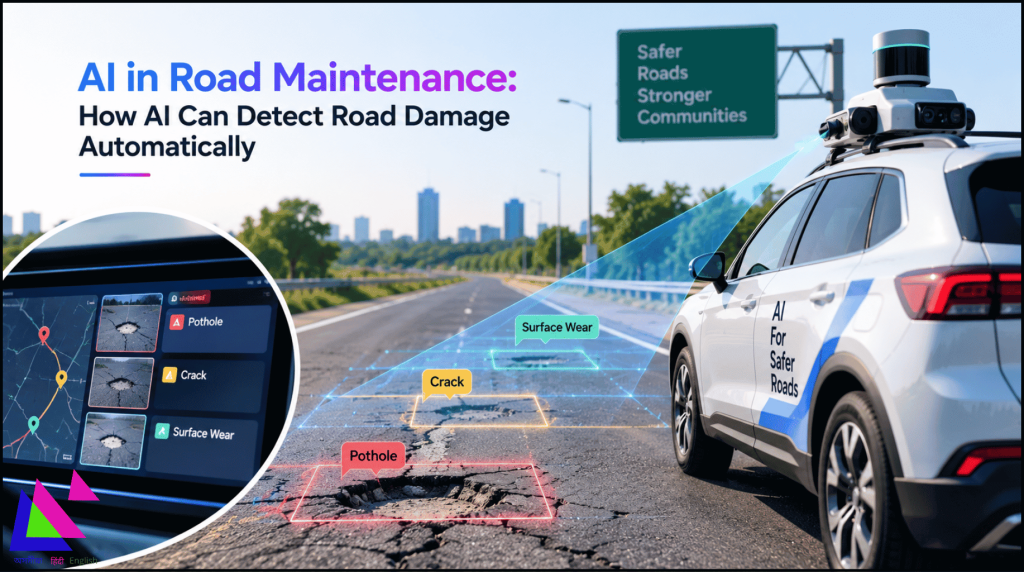
How Does AI Detect Road Damage?
AI-based road monitoring usually works with images or video captured from vehicles, smartphones, drones or other cameras.
A basic process looks like this:
Camera → Image/Video → AI Analysis → Damage Detection → Location Record
The system can identify visible problems such as:
- Potholes.
- Cracks.
- Broken road surfaces.
- Other forms of visible road damage.
Research has already explored computer vision models for automatically identifying different types of road defects.
What Is Happening in Bengaluru?
The Bengaluru project provides a practical example of how AI can connect road detection with civic action.
According to reports, the system records potholes using vehicle-mounted data and creates a digital record containing location information. It can also connect detected problems with government road contracts to identify the responsible contractor.
During one commute, the system reportedly detected 12 potholes.The important idea is not simply detecting a pothole. It is creating information that authorities can potentially use for follow-up and accountability.
Why Is This Useful?
Manual road inspections can take time and require people to physically examine large areas.
AI can process large amounts of visual information more quickly.
It could help authorities:
- Identify damaged roads.
- Record exact locations.
- Prioritize repairs.
- Monitor road conditions.
- Track repeated problems.
- Create digital maintenance records.
As a result, road agencies could move toward more regular monitoring instead of waiting for complaints.
AI Can Support Preventive Maintenance
AI in Road Maintenance can also help shift the focus from fixing roads only after major damage appears to identifying problems earlier.
For example, regular road scans could create a history of damage.
Authorities could then compare:
- Previous road condition.
- Current road condition.
- New cracks or potholes.
- Areas where damage is increasing.
- Roads that need urgent attention.
This information could help maintenance teams plan their work more efficiently.
Benefits of AI-Based Road Monitoring
1. Faster Detection: AI can analyze large numbers of images or video frames quickly.
2. Better Records: Digital records can show where damage was detected and when.
3. Wider Coverage: Vehicles can collect road information while travelling through different areas.
4. Better Maintenance Planning: Authorities can use collected information to prioritize repair work.
5. Greater Accountability: Systems that connect damage with road contracts can make it easier to identify responsible parties, as demonstrated by the Bengaluru project.
Limitations and Challenges
AI is not a perfect replacement for physical road inspections.
- Image Quality: Poor lighting, rain, dirt or unclear images can affect detection.
- False Results: AI may sometimes identify an object as road damage when it is not, or miss a real problem.
- Different Road Conditions: Road surfaces vary by region, material, weather and traffic.
- Data Requirements: AI models need suitable training data to work reliably across different environments.
- Human Verification: Authorities may still need people to confirm serious damage before ordering repairs.
Could Smartphones Help?
Yes. Researchers are also exploring datasets and systems that support road-damage detection using images collected from accessible devices.
This could make monitoring more affordable because authorities would not always need specialized survey vehicles.However, the quality of the camera, GPS information and AI model still affects the result.
What Could Happen Next?
AI in Road Maintenance could become part of wider smart-city systems.
Future systems could combine:
- AI cameras.
- GPS.
- Smartphone data.
- Drones.
- Satellite imagery.
- Road condition databases.
- Maintenance records.
Together, these tools could give authorities a clearer picture of how roads are changing over time.
Conclusion
AI in Road Maintenance is moving from research into practical civic applications. The Bengaluru project shows how AI can detect potholes while also connecting road damage with location and contractor information.
The technology will not remove the need for human inspections. Instead, it can help authorities find problems faster, organize information and decide where maintenance may be needed first.
If these systems become more accurate and affordable, AI could become a useful part of keeping roads safer, better monitored and easier to maintain.
FAQs
1. How does AI detect potholes?
Ans: AI can analyze images or video and identify visual patterns associated with potholes, cracks and other road damage.
2. Can AI replace road inspectors?
Ans: No. AI can support inspections, but human verification remains useful for important maintenance decisions.
3. Can smartphones detect road damage?
Ans: Smartphone cameras and sensors can be used for road-monitoring systems, although accuracy depends on the hardware and AI model.
4. What are the benefits of AI road monitoring?
Ans: It can help detect damage faster, create digital records, improve monitoring and support maintenance planning.
5. What is the biggest challenge?
Ans: AI must work reliably across different road surfaces, weather conditions, lighting and types of damage.

Hi, I’m Dev Kirtonia, Founder & CEO of Dev Library. A website that provides all SCERT, NCERT 3 to 12, and BA, B.com, B.Sc, and Computer Science with Post Graduate Notes & Suggestions, Novel, eBooks, Biography, Quotes, Study Materials, and more.







 Buy Now