
Industrial AI is changing the way modern factories operate. Traditional automation follows predefined instructions, while AI systems can analyze real-time data, identify patterns and help make decisions based on changing conditions.
This shift is moving factories from simply automated systems toward more intelligent and adaptive production environments.Samsung, for example, announced a strategy in March 2026 to transition its global manufacturing operations into AI-Driven Factories by 2030. The plan includes AI agents, digital twins, predictive maintenance, logistics and quality control.
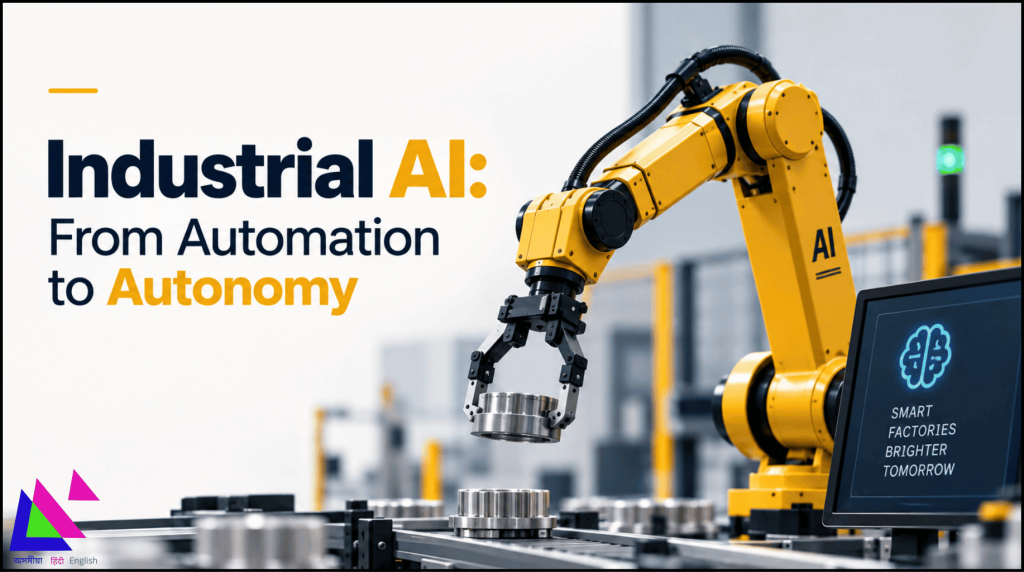
Automation vs AI-Driven Manufacturing
Traditional automation works well when a process stays predictable.But factories are not always predictable.Machines wear out, production requirements change, supply chains face disruptions and unexpected problems can occur.
Traditional automation:
Follow programmed instructions.
AI-driven manufacturing:
Analyze data → Understand conditions → Recommend or take an appropriate action.
This difference could make factories more flexible.
Where Is AI Being Used?
1. Predictive Maintenance: AI can analyze machine data such as:
- Temperature.
- Vibration.
- Pressure.
- Operating history.
The system can look for unusual patterns that may indicate a developing problem.Instead of waiting for equipment to fail, maintenance teams can investigate earlier.
2. Quality Control: AI-powered vision systems can inspect products for visible defects.
They can help identify:
- Incorrect assembly.
- Surface defects.
- Missing components.
- Packaging problems.
This can support faster and more consistent inspection.
3. Production Planning: AI can analyze production data and help companies adjust workflows according to changing requirements.
4. Logistics: Factories need to move materials between different stages of production.AI can help coordinate inventory, transportation and internal material movement.
Samsung’s AI Factory Plan
Samsung’s strategy provides a useful real-world example.The company plans to integrate AI across its manufacturing value chain, from incoming materials and production to quality inspection and final shipment. It also plans to use specialized AI agents for quality control, production and logistics.
Samsung also plans to use digital twins to simulate manufacturing processes and deploy specialized robots for production, logistics and safety-related tasks.
What Are Digital Twins?
A digital twin is a digital representation of a physical system.In manufacturing, it can help companies simulate and analyze processes before making changes to the real production environment.
This can help companies:
- Test production changes.
- Identify potential problems.
- Study different scenarios.
- Improve planning.
- Reduce unnecessary physical testing.
When combined with AI, digital twins can become a powerful tool for factory optimization.
What Happens to Factory Workers?
The rise of Industrial AI does not automatically mean factories will stop needing workers. Instead, some jobs may change.
Workers may increasingly focus on:
- Monitoring AI systems.
- Maintaining advanced equipment.
- Managing robots.
- Handling complex problems.
- Making safety decisions.
- Reviewing AI recommendations.
At the same time, companies will need to train workers to use these new technologies effectively.
Benefits & Risks
- Higher Efficiency: AI can identify patterns and improve production decisions.
- Less Downtime: Predictive maintenance can help identify potential equipment problems earlier.
- Better Quality: AI inspection can support automated quality checks.
- Improved Safety: AI can monitor certain workplace conditions and identify potential hazards.
- More Flexible Production: AI systems can potentially respond better to changing production conditions.
What Are the Risks?
The move toward intelligent factories also creates challenges.
- Cost: Installing sensors, computing systems, robots and AI software can require major investment.
- Cybersecurity: More connected equipment creates more digital entry points that companies need to protect.
- Reliability: Factories cannot depend on AI systems that make frequent or unpredictable mistakes.
- Workforce Training: Employees need new technical skills as production systems become more sophisticated.
- Human Oversight: Safety-critical decisions require appropriate human controls.
Are Fully Autonomous Factories Close?
Some parts of factories can already operate with high levels of automation.However, a completely autonomous factory is a much bigger challenge.Real factories contain unexpected situations that require judgment, maintenance and human intervention.So, the more realistic near-term direction is increasing autonomy, rather than removing humans from every process.
What’s Next?
Industrial AI could gradually connect more parts of the factory.
A future production system could combine:
Sensors + AI + Robots + Digital Twins + Human Workers
Each part would perform a different role. AI could analyze information, robots could perform physical tasks, digital twins could simulate changes, and humans could supervise the overall system and handle complex decisions.
Conclusion
Industrial AI is taking factory automation into a new phase. Companies are using AI for predictive maintenance, quality control, logistics, safety and production planning, while manufacturers such as Samsung are planning larger AI-driven factory networks.
The biggest change may not be the disappearance of human workers. Instead, factories could become environments where people, AI and robots work together.
As the technology improves, the competitive advantage may come from how effectively companies combine intelligent software with skilled workers and reliable industrial systems.
FAQs
1. What is Industrial AI?
Ans: Industrial AI means using artificial intelligence in manufacturing and industrial operations.
2. How does AI help factories?
Ans: It can support maintenance, quality inspection, production planning, logistics and safety.
3. What is predictive maintenance?
Ans: It uses equipment data to identify signs of potential problems before a machine fails.
4. Will AI replace factory workers?
Ans: Some repetitive tasks may become automated, but people will still be needed for supervision, maintenance, engineering and complex decisions.
5. What is an AI-driven factory?
Ans: It is a manufacturing environment where AI is integrated into processes such as production, quality control, logistics and maintenance. Samsung aims to transition its global manufacturing operations toward AI-driven factories by 2030.

Hi, I’m Dev Kirtonia, Founder & CEO of Dev Library. A website that provides all SCERT, NCERT 3 to 12, and BA, B.com, B.Sc, and Computer Science with Post Graduate Notes & Suggestions, Novel, eBooks, Biography, Quotes, Study Materials, and more.




 Buy Now