
Class 12 Physics Important Chapter 3 Current Electricity Solutions English Medium As Per The New Syllabus to each chapter is provided in the list so that you can easily browse through different chapters ASSEB Class 12 Physics Additional Solutions in English and select need one. NCERT Class 12 Physics Additional Solutions Download PDF. HS 2nd Year Physics Important Solutions.
Class 12 Physics Important Chapter 3 Current Electricity
Also, you can read the NCERT book online in these sections Solutions by Expert Teachers as per Central Board of Secondary Education (CBSE) Book guidelines. CBSE Class 12 Physics Additional Question Answer are part of All Subject Solutions. Here we have given HS 2nd Physics Important Solutions English Medium for All Chapters, You can practice these here.
Current Electricity
Chapter: 3
| IMPORTANT QUESTION AND ANSWER |
Answer The Following Questions:
1. Why is potentiometer preferred over a voltmeter for determining the emf of a cell.
Ans. Potentiometer does not draw any (net) current from the cell. Voltmeter draws some current from cell, when connected across at, hence measures terminal voltage.
2. Define mobility of a charge carrier. What is its relation with relaxation time?
Ans. Mobility of a charge carrier as the drift velocity acquired by it in a unit electric field.
μ = eτ/m
3. Write two special characteristics of manganin due to which it is used in making standard resistances?
Ans. (i) The temperature coefficient of resistance for manganin is low.
(ii) Manganin has a high value of resistivity.
4. What do you understand by electromotive force? State its S.I. unit?
Ans. E.M.F. of a cell is the maximum potential difference across the two electrodes of the cell when no current is drawn from the cell or cell in the open circuit S.I. unit of e.m.f. of a cell is volt.
5. Explain the significance of direction of electric current in a circuit.
Ans. The conventional direction of electric current in a circuit tells the direction of flow of positive charge. The direction of flow of electrons gives the direction of electric current, which is opposite to that of conventional current.
6. How does electric field vary with drift velocity?
Ans: Electric field intensity is directly proportional to drift velocity.
7. Why are copper wires used as connecting wires?
Ans. Copper wires are used as connecting wires because electrical conductivity of copper is high and its electrical resistivity is low.
8. Why is wheatstone bridge (or metre bridge) method considered unsuitable for the measurement of very low resistances? [V. Imp.]
Ans. For measuring low resistance, all other resistances used should have low value to ensure the sensitivity of the bridge. This requires a galvanometer of very low resistance which itself would be very sensitive. Also, the end-resistances and resistances of connecting wires become comparable to the resistance being measured and introduce error in the result.
9. When electrons drift in a metal from lower to higher potential, does it mean that all the free electrons of the metal are moving in the same direction?
Ans. No, only the drift velocities of the electrons are superposed over their random thermal velocities.
10. State the principle of a potentiometer.
Ans. A potentiometer works on the principle that when a steady current flows through a wire of uniform cross-section and composition, the potential drop across any length of the wire is directly proportional to that length.
11. What is drift velocity? Describe.
Ans: Drift velocity (vₐ): The average velocity of free electrons in a conductor under the influence of an electric field.

Where e = charge of electron, E = electric field, τ = relaxation time, m = mass of electron.
Though electrons move randomly, the electric field causes a net small movement called drift. This slow movement constitutes current in conductors.
12. What is mobility? Give its SI unit.
Ans: Mobility (μ): It is the drift velocity per unit electric field.
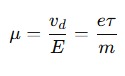
SI unit: m²·V⁻¹·s⁻¹
13. Differentiate conductors and insulators.
Ans:
| Conductors | Insulators |
| (i) Allow free flow of charge | (i) Do not allow charge flow |
| (ii) Have low resistivity | (ii) Have very high resistivity |
| (iii) Examples: Copper, Silver | (iii) Examples: Rubber, Glass |
14. Why high voltage is used for power transmission?
Ans: Power loss in transmission wires:
Ploss=I2R
Since P = VI = VI we get:
To reduce power loss, V is increased so that current I becomes small, minimizing I2R losses. This is why long-distance lines use very high voltage.
15. What is a meter bridge? What principle is used?
Ans: Meter Bridge: A device based on Wheatstone bridge principle used to compare unknown resistance.

Hi, I’m Dev Kirtonia, Founder & CEO of Dev Library. A website that provides all SCERT, NCERT 3 to 12, and BA, B.com, B.Sc, and Computer Science with Post Graduate Notes & Suggestions, Novel, eBooks, Biography, Quotes, Study Materials, and more.
Subject Ka Complete Video Solution Dekhein
Step-by-step easy concept explanation aur full questions Answer ke liye watch karein ya app download karein:


 Buy Now