
AI Long-Term Memory could change the way people interact with AI assistants. Most AI systems can remember information within a conversation, but they may lose important context once the conversation ends or becomes too long.
Long-term memory aims to solve this problem by allowing an AI system to store and retrieve selected information from previous interactions. Instead of starting from zero every time, an AI assistant could use relevant past context when helping a user.
However, this does not mean AI should remember everything. A useful memory system needs to decide what information is important, what should be forgotten and when stored information should be used.
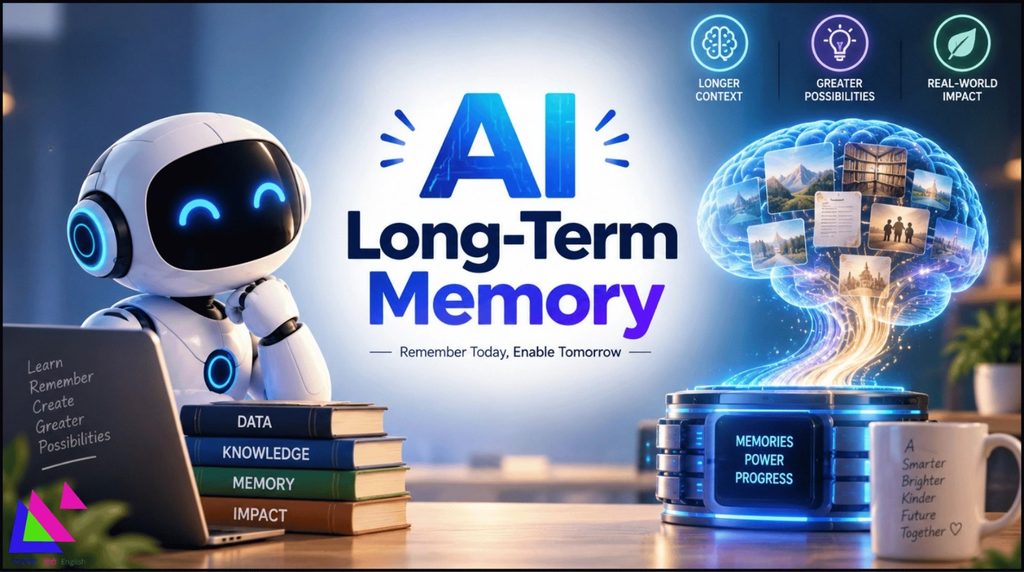
How Does AI Long-Term Memory Work?
An AI assistant does not necessarily keep every previous conversation active at the same time. Instead, a memory system can store selected information separately.
When a new request arrives, the system searches for relevant information and brings that context into the current interaction.
For example, an AI assistant might remember a user’s preferred writing style or an ongoing project. When the user returns later, the assistant can use that information without requiring the user to explain everything again.This makes AI Long-Term Memory different from simply increasing the size of a model’s context window.
Why Is Memory Important for AI Assistants?
Without memory, users may need to repeat the same information again and again.
A system with useful long-term memory could provide a more continuous experience. This may be especially helpful for assistants used over weeks or months.
Possible Uses of AI Long-Term Memory
- Personal Assistance: Remembering selected preferences and recurring tasks.
- Long-Term Projects: Keeping track of previous work and decisions.
- Customer Support: Using relevant information from earlier interactions.
- Learning Support: Remembering a student’s progress or previously discussed topics.
- Workflows: Maintaining useful context across multiple tasks.
The key idea is relevance. The AI should retrieve information that helps with the current task instead of bringing up unrelated details.
Benefits
- Less Repetition: Users may not need to explain the same context repeatedly.
- Better Continuity: AI can maintain context across longer projects.
- More Personalized Responses: Assistants can adapt to selected user preferences.
- Improved Productivity: Ongoing work may continue more smoothly.
- Better Context: AI can use relevant past information when answering new questions.
Challenges and Privacy Concerns
AI memory also creates important questions.
- Privacy: Users need control over what information is stored.
- Incorrect Memories: AI may store or retrieve information incorrectly.
- Outdated Context: A previous preference or fact may no longer be relevant.
- Too Much Memory: Remembering unnecessary information can make the system less useful.
- Security: Stored information must be protected from unauthorized access.
Because of these issues, AI Long-Term Memory needs clear controls that allow users to review, change or delete stored information.
Memory Is Not the Same as Human Memory
It is important not to compare AI memory too directly with human memory.An AI system does not necessarily remember experiences in the same way a person does. Its memory may involve stored data, summaries or information retrieved from a database.
The system may also fail to retrieve relevant information or bring back incorrect context. Therefore, AI Long-Term Memory should be viewed as a technical capability designed to improve continuity rather than proof that AI has human-like memory.
What Could Change in the Future?
As AI assistants become part of daily work and personal tasks, memory could become more important.People may expect AI to understand ongoing projects and remember useful preferences. At the same time, users will likely demand greater control over what the AI remembers.
The future may involve smarter memory systems that store only useful information and retrieve it when needed.
Conclusion
AI Long-Term Memory could make AI assistants more useful by reducing repetition and improving continuity across conversations and projects.
However, memory must be accurate, relevant and controlled by the user. Remembering more information is not automatically better.
The real goal is to build AI systems that remember the right information at the right time while respecting privacy and user control.
FAQs
1. What is AI Long-Term Memory?
Ans: It allows an AI system to store and retrieve selected information across conversations or longer periods.
2. Why is AI memory useful?
Ans: It can reduce repetition and help AI maintain context across ongoing tasks.
3. Does AI remember everything?
Ans: Not necessarily. A well-designed memory system may store only selected or relevant information.
4. What are the main risks of AI memory?
Ans: Privacy issues, incorrect memories, outdated information and security risks are important concerns.
5. Is AI memory the same as human memory?
Ans: No. AI memory generally relies on stored and retrieved information rather than human-like experiences.

Hi, I’m Dev Kirtonia, Founder & CEO of Dev Library. A website that provides all SCERT, NCERT 3 to 12, and BA, B.com, B.Sc, and Computer Science with Post Graduate Notes & Suggestions, Novel, eBooks, Biography, Quotes, Study Materials, and more.
Subject Ka Complete Video Solution Dekhein
Step-by-step easy concept explanation aur full questions Answer ke liye watch karein ya app download karein:







 Buy Now