
On-Device AI: Why Artificial Intelligence Is Moving From the Cloud to Your Device
On-Device AI is becoming an important part of the next stage of artificial intelligence. Instead of sending every request to a distant cloud server, some AI tasks can now run directly on a smartphone, laptop or other device.
Cloud-based AI remains important, especially for large and complex models. However, local processing offers advantages that are useful for everyday applications.
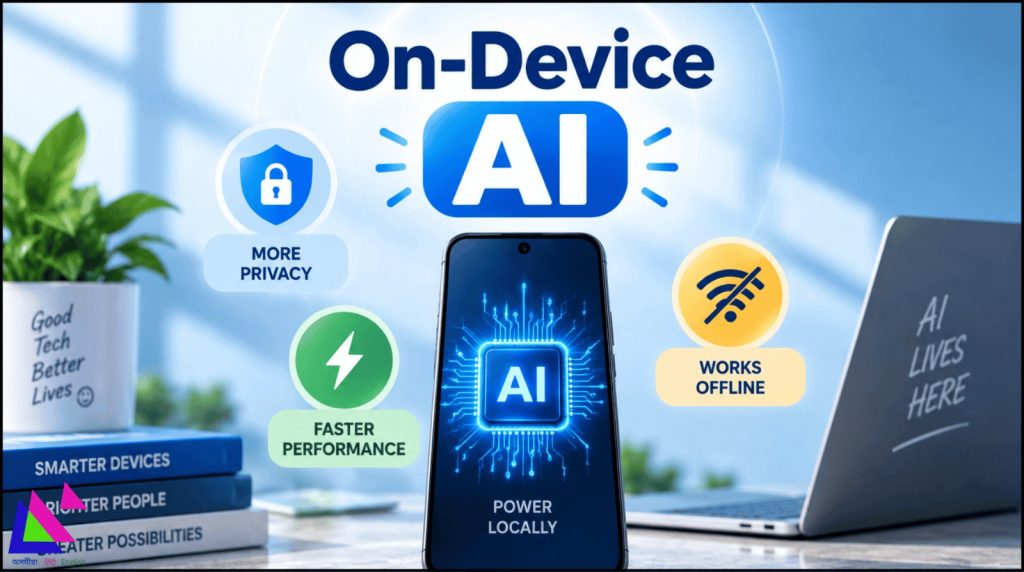
The basic idea is simple: when an AI task can run on your device, some data may not need to leave the device for processing. This can improve response speed and support AI features even when an internet connection is unavailable.
How Is It Different From Cloud AI?
Cloud AI processes requests using remote servers. The user’s device sends data over the internet, and the server returns a result.On-Device AI processes supported tasks locally using the hardware inside the device.
Modern smartphones and computers increasingly include specialized hardware designed to handle AI workloads. However, devices have less computing power and memory than large data centres, so not every AI task can run locally. As a result, many products are likely to use a combination of local and cloud-based AI.
Also Read: Energy Efficient AI: Why the AI Industry Is Now Focused on Using Less Energy
Where Can On-Device AI Be Useful?
It can support many everyday features:
- Voice Processing: Some speech recognition tasks can run locally.
- Image Features: AI can help improve photos or analyse images on the device.
- Writing Assistance: Selected text-related tasks can be processed locally.
- Smart Suggestions: Devices can provide recommendations based on local information.
- Offline Features: Some AI tools can continue working without an active internet connection.
The exact features depend on the hardware and software available on a particular device.
Benefits
- Better Privacy: Some data can remain on the user’s device instead of being sent to a remote server.
- Faster Responses: Local processing can reduce delays caused by sending data over a network.
- Offline Functionality: Certain AI features can work without an internet connection.
- Lower Cloud Dependence: Not every task requires access to a large data centre.
- More Personalised Features: Local AI can potentially use information stored on the device while keeping more processing private.
Challenges and Limitations
- Limited Computing Power: Phones and laptops cannot match the scale of large AI data centres.
- Battery Use: Running AI workloads locally can consume additional power.
- Storage and Memory Limits: Larger AI models may not fit efficiently on every device.
- Hardware Differences: Older devices may not support advanced local AI features.
- Complex Tasks Still Need the Cloud: Large-scale reasoning or generation may require powerful remote servers.
Why Is This Trend Important?
AI is becoming part of everyday devices, from smartphones and computers to other connected products.If every AI request depends entirely on a cloud connection, users may face issues related to internet access, response time and data sharing.
On-Device AI offers another approach by moving selected AI tasks closer to the user.This can also help companies build hybrid systems. Simple or privacy-sensitive tasks can run locally, while more demanding requests can move to the cloud when necessary.
The Future May Be Hybrid
The future of AI may not be a choice between local processing and cloud processing.Instead, devices may intelligently decide where a task should run.
For example, a quick voice command could be processed locally, while a much larger task could be sent to a cloud-based AI model.This hybrid approach could combine the strengths of both systems.
Conclusion
On-Device AI is changing how artificial intelligence can work on everyday devices. By processing selected tasks locally, it can offer faster responses, greater privacy and offline functionality.
However, local devices still have limitations in computing power, battery capacity and memory.
For this reason, the future of On-Device AI will likely involve a combination of local and cloud processing. Users may not always notice where the AI is running—but the system could choose the most suitable option based on the task.
FAQs
1. What is On-Device AI?
Ans: It refers to AI tasks that are processed directly on a device instead of entirely on remote cloud servers.
2. Is On-Device AI more private?
Ans: It can improve privacy because some data may remain on the device instead of being sent to external servers.
3. Can it work without the internet?
Ans: Yes, some supported AI features can work offline.
4. Can it replace cloud AI?
Ans: Not completely. Large and complex tasks may still require powerful cloud infrastructure.
5. What devices can use it?
Ans: Modern smartphones, laptops and other devices with suitable AI hardware can support selected on-device AI features.
Subject Ka Complete Video Solution Dekhein
Step-by-step easy concept explanation aur full questions Answer ke liye watch karein ya app download karein:







 Buy Now