
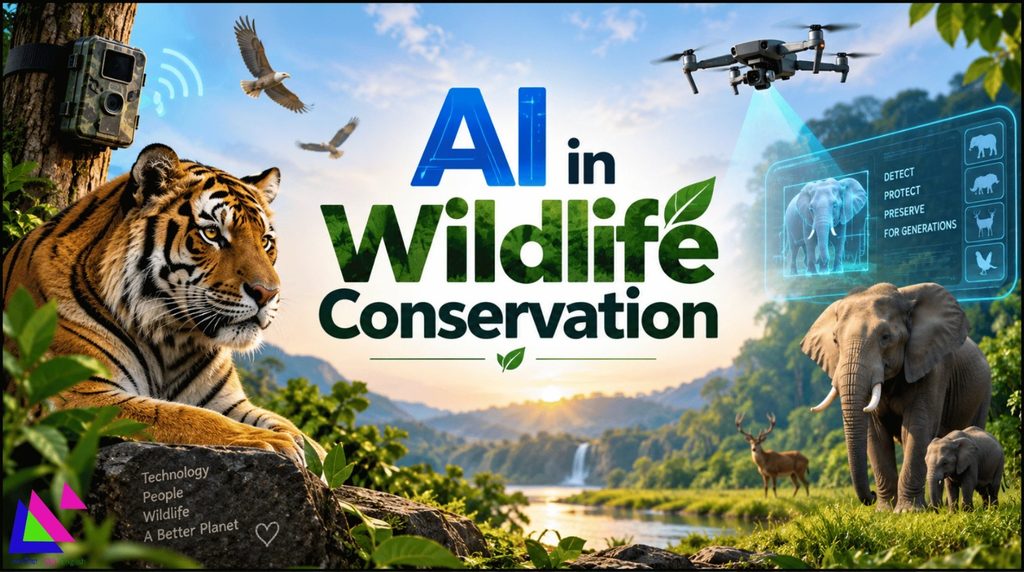
AI in Wildlife Conservation is giving researchers new ways to monitor animals and protect vulnerable ecosystems. Tracking wildlife across large forests, oceans and remote areas is difficult, especially when researchers have limited time and resources.
Conservation teams collect information from camera traps, satellites, drones and audio recorders. However, analysing thousands of images or hours of sound recordings manually can take a huge amount of time.AI can help researchers process this information faster and identify patterns that may otherwise be difficult to detect.
How Does AI Help Monitor Wildlife?
One common example involves camera traps. These cameras automatically capture images when an animal moves nearby.
A large wildlife project can produce thousands or even millions of images. AI in Wildlife Conservation can help sort these images and identify which ones may contain particular animals.
AI can also analyse audio recordings. Researchers can place microphones in forests or other habitats and use AI to detect animal calls.This allows scientists to collect information without physically observing every animal.
Where Can AI Be Used?
AI can support conservation work in several ways:
- Camera Trap Analysis: Identifying animals from large collections of images.
- Acoustic Monitoring: Detecting animal sounds and calls.
- Satellite Analysis: Studying forests, habitats and environmental changes.
- Animal Tracking: Analysing movement patterns.
- Threat Detection: Supporting efforts to identify unusual activity or possible environmental threats.
These tools can help researchers focus their attention on information that requires human expertise.
Benefits of AI in Wildlife Conservation
- Faster Analysis: AI can process large datasets more quickly.
- Remote Monitoring: Researchers can study difficult-to-reach locations.
- Better Data Collection: Automated systems can gather information continuously.
- Earlier Detection: AI may help identify changes or threats sooner.
- More Efficient Research: Scientists can spend less time sorting raw data manually.
For large conservation projects, AI in Wildlife Conservation can make existing monitoring tools more useful.
Challenges and Limitations
AI is not a complete solution for protecting wildlife.
- Incorrect Identification: AI can mistake one animal for another.
- Poor Data Quality: Blurry images or unclear recordings can affect results.
- Limited Infrastructure: Remote areas may lack reliable power or internet access.
- High Setup Costs: Cameras, sensors and computing systems can be expensive.
- Need for Experts: Scientists must still verify important findings.
Technology can provide information, but conservation decisions still require local knowledge and scientific expertise.
AI Cannot Solve the Whole Conservation Problem
An AI system may detect that an endangered animal is present in a forest. However, it cannot automatically solve problems such as habitat destruction, illegal hunting or climate change.
Those issues require governments, conservation organizations, local communities and researchers to take action.
Therefore, AI in Wildlife Conservation works best as a supporting tool. It can improve monitoring and provide better information, but humans must decide what action to take.
Why This Technology Matters
Wildlife populations and ecosystems can change quickly. In many cases, researchers need better information before they can understand what is happening.AI can help transform large amounts of raw information into something more useful.
For example, instead of manually reviewing every image from a camera trap, researchers can use AI to identify the most relevant images for further examination.This could help conservation teams use limited time and resources more effectively.
Conclusion
AI in Wildlife Conservation is showing how technology can support efforts to understand and protect the natural world.
From identifying animals in camera-trap images to analysing sounds and environmental data, AI can help researchers process information at a much larger scale.
However, technology alone cannot protect endangered species. The most effective approach combines AI tools with scientists, conservation workers and local communities.In the future, AI in Wildlife Conservation may become an increasingly valuable tool—but human action will remain essential.
FAQs
1. What is AI in Wildlife Conservation?
Ans: It involves using AI to support wildlife monitoring, animal identification, habitat analysis and conservation research.
2. Can AI identify animals in photos?
Ans: Yes. AI can help analyse camera-trap images and identify certain animals.
3. How can AI analyse animal sounds?
Ans: AI can process audio recordings and identify patterns associated with particular animal calls.
4. Can AI stop poaching automatically?
Ans: No. AI can support monitoring and threat detection, but human action is required to respond.
5. Will AI replace wildlife researchers?
Ans: No. AI can help process data, while researchers remain essential for verification and conservation decisions.

Hi, I’m Dev Kirtonia, Founder & CEO of Dev Library. A website that provides all SCERT, NCERT 3 to 12, and BA, B.com, B.Sc, and Computer Science with Post Graduate Notes & Suggestions, Novel, eBooks, Biography, Quotes, Study Materials, and more.
Subject Ka Complete Video Solution Dekhein
Step-by-step easy concept explanation aur full questions Answer ke liye watch karein ya app download karein:







 Buy Now