
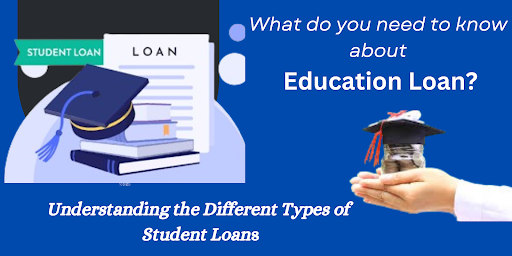
Understanding the Different Types of Student Loans helps students make better financial decisions. These loans may differ from other types of loans because they often have lower interest rates and flexible repayment options, including deferred payments while the student is still in school. Knowing the Different Types of Student Loans is important, as they are borrowed funds that must be repaid, usually with interest, after graduation or when the student leaves school.
Types of Loans
Federal Student Loans: Federal student loans are the most common type of student loan. There are four main types of federal student loans: subsidized, unsubsidized, parent loans, and consolidation loans. These loans are provided by the government and often come with lower interest rates, borrower protections, and flexible repayment options.
- Subsidized Loan: Direct Subsidized Loans are available to undergraduate students with financial need.The government pays the interest while you’re in school, during deferment, and during a grace period.
- Direct Unsubsidized Loans: Unsubsidized Loans are loans for both undergraduate and graduate students that are not based on financial need. Interest begins accruing as soon as the loan is disbursed.
- Parent Loans: Direct PLUS Loans for parents are unsubsidized loans made to parents of dependent undergraduate students.Requires a credit check and has a higher interest rate than other federal loans.
- Consolidation Loans: Allows borrowers to combine multiple federal loans into a single loan with one monthly payment. This can be a good way of taking control of your finance,s but you need to be careful. A consolidation loan may not always be your best option.
Benefits/Features of Federal Student Loan
Access to income-driven repayment plans: The Department of Education offers several income-driven repayment plans, which can reduce your monthly payment to as little as 10 percent of your discretionary income.
- No credit history needed.
- No cosigner needed.
Fixed Interest Rates: Federal student loans have fixed interest rates that remain constant throughout the life of the loan.
- Fixed interest rates.
- Lower interest rates than private loans.
- Interest accrual may begin after college.
No Prepayment Penalty: Borrowers can pay off federal student loans early without any additional fees or penalties.
- Forbearance and deferment options.
- A repayment grace period.
- Income-driven repayment options.
| Pros | Cons |
| Loan Forgiveness Options | No Customization of Terms |
| Flexible Repayment Plans | Limited Eligibility for Certain Loans |
| Lower Fixed Interest Rates | Borrowing Limits |
Private Student Loan: These loans are offered by private lenders such as banks, credit unions, or online lenders. They are not part of the federal student loan program and generally do not feature the flexible repayment terms or borrower protections offered by federal student loans.
Benefits/Features of Private Student Loan
- Private loans often allow students to borrow more than federal loans.
- Private loans may offer both fixed and variable interest rate options.
- The application process for private loans is typically fast and straightforward.
| Pros | Cons |
| Can be cheaper than federal loans. | No access to income-driven repayment or forgiveness. |
| Fast application process. | There’s no federal subsidy. |
| Higher borrowing limits. | Risks of overborrowing. |
Difference between Federal and Private loans
| Features | Federal Student Loan | Private Student Loan |
| Source | Offered by the government | Offered by private lenders |
| Eligibility | Based on financial need, no credit check for most loans. | Requires a credit check; may need a cosigner. |
| Tax benefits | Interest may be tax deductible. | Interest may be tax deductible. |
| Consolidation and Refinancing | Loans can be consolidated into a Consolidation loan. | private student loans cannot be consolidated into a Direct Consolidation Loan but may be refinanced. |
| Grace Period | Repayment typically starts 6 months after leaving school or dropping below half-time enrollment. | Varies; some require repayment while still in school. |
| Loan Forgiveness | Eligible for forgiveness programs, such as Public Service Loan Forgiveness. | Forgiveness options are rare or nonexistent. |
| Prepayment penalties | There is no prepayment penalty fee. | You need to make sure there are no prepayment penalty fees. |
Difference between Subsidized and Unsubsidized loans
| Features | Subsidized Loan | Unsubsidized loan |
| Interest Subsidy | The government covers the interest on subsidized loans while the borrower is in school at least half-time during the grace period after leaving school. | Interest on unsubsidized loans begins accruing from the time the loan is disbursed. The borrower is responsible for the interest during all periods. |
| Availability | Only available to undergraduate students. | Available to both undergraduate and graduate students. |
| Loan Limit | Has lower annual and aggregate borrowing limits. | Higher borrowing limits than subsidized loans. |
| Financial Need | Eligibility for subsidized loans is determined based on financial need through the Free Application for Federal Student Aid. | Eligibility for unsubsidized loans is not based on financial need. |
| Loan Limit | Has lower annual and aggregate borrowing limits. | Higher borrowing limits than subsidized loans. |
| Interest Rates | Subsidized loans typically have lower fixed interest rates compared to unsubsidized loans. | Unsubsidized loans also have fixed interest rates set by the government, but these rates are generally higher than those for subsidized loans. |
| Responsibility for Interest | Government covers interest during certain periods. | Borrower is responsible for all interest accrued. |
When to apply for private student loans and federal student loans
Federal Student: It’s a good idea to apply for federal loans early since they have hard deadlines and some aid is awarded on a first-come, first-served basis. Prioritizing early submission for federal deadlines can improve your chances of receiving financial aid and admission to college.
Private Student Loans: Private student loans don’t have specific deadlines, but it can take as long as a month for your school to receive the funds. Most private lenders allow you to apply at any time during the year.
Terms and conditions of federal loans vs private loans
- Loan Type: Check whether the loan is federal or private.
- Loan Servicer: Know who manages your loan and payments.
- Cosigner: Federal loans usually don’t need a cosigner; private loans may require one.
- Interest Rate: Understand the interest rate and total cost.
- Rate Type: Confirm if the rate is fixed or variable.
- Repayment: Know when repayment starts (during or after studies).
- Grace Period: Check if there is time after studies before repayment begins.
- Late Payment Charges: Be aware of penalties for missed payments.
- Prepayment: Confirm if early repayment is allowed without extra fees.
Conclusion
Student loans play a vital role in making higher education accessible to students from all backgrounds and income levels. Understanding the Different Types of Student Loans is equally important, as it helps students choose the right option for their needs. While these loans offer an opportunity to pursue academic and professional goals, they also come with responsibilities and potential financial burdens after graduation.
Read Also
- Impact of Policy Change on Student Loan Borrowers
- Financial Literacy: Preparing for Student Loans Before College
FAQs
1. What is a student loan?
Ans: A student loan is borrowed money used to pay for education expenses, which must be repaid with interest.
2. What is the difference between federal and private student loans?
Ans: Federal loans are provided by the government with lower interest rates and flexible repayment options, while private loans are offered by banks or lenders with varying terms.
3. Are federal loans better than private loans?
Ans: Federal loans are generally better due to lower interest rates, income-driven repayment plans, and loan forgiveness options.
4. What is loan forgiveness?
Ans: Loan forgiveness is a program that cancels part or all of a student loan under certain conditions, such as public service work.
5. What is important to know before applying for a loan?
Ans: Check the loan type, interest rate, repayment terms, and eligibility criteria before applying.

Hi, I’m Dev Kirtonia, Founder & CEO of Dev Library. A website that provides all SCERT, NCERT 3 to 12, and BA, B.com, B.Sc, and Computer Science with Post Graduate Notes & Suggestions, Novel, eBooks, Biography, Quotes, Study Materials, and more.
 Buy Now