
AI in Drug Discovery: Can AI Help Develop New Medicines Faster?
AI in Drug Discovery is gaining serious attention as pharmaceutical companies look for ways to improve the long and expensive process of developing new medicines. Discovering a potential medicine involves many stages. Researchers need to understand diseases, identify possible biological targets, design or select drug candidates and test whether they are safe and effective.
AI cannot remove these stages completely. However, it can help researchers process large amounts of scientific information and identify useful patterns more quickly.
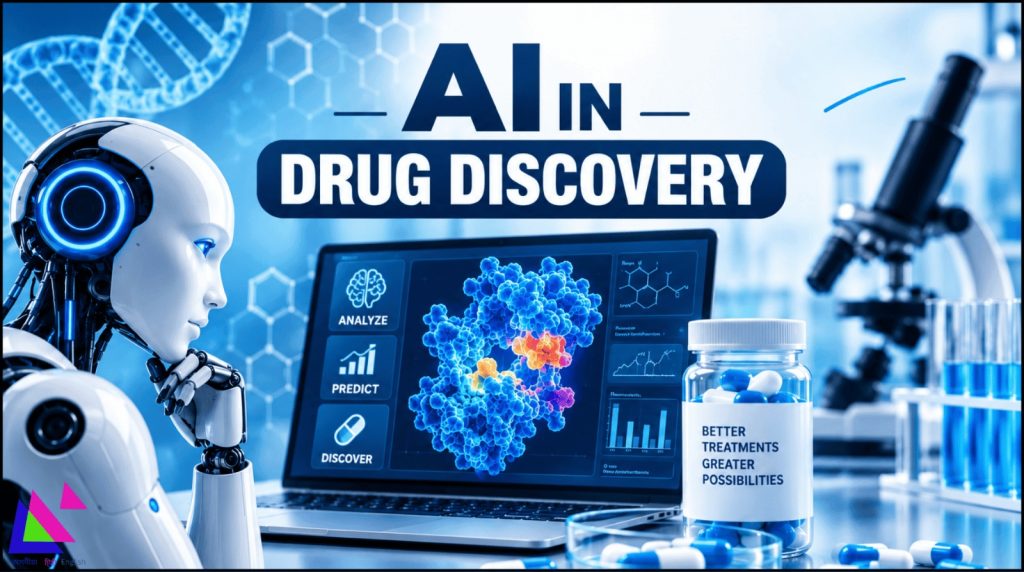
In August 2026, Reuters reported that pharmaceutical companies were increasingly investing in AI, new modelling tools and automated laboratories in an effort to improve research efficiency and potentially reduce development costs and timelines.
How Can AI Help the Discovery Process?
Traditional drug research involves analysing enormous amounts of biological and chemical information.
AI can help researchers examine this information and identify possible relationships that may otherwise take much longer to study.For example, AI in Drug Discovery can support the search for possible drug targets or help researchers evaluate large numbers of potential compounds.
However, identifying a promising candidate is only the beginning. Scientists still need laboratory testing and clinical trials before a medicine can reach patients.
Where AI Can Support Researchers
AI can be useful at different stages of early research.
- Drug Target Identification: AI can help analyse biological data and identify possible targets.
- Molecule Analysis: Researchers can use AI to explore chemical and molecular information.
- Data Processing: AI can process large scientific datasets more quickly.
- Research Prioritisation: Models can help scientists decide which possibilities deserve further investigation.
- Automated Research: AI can increasingly work alongside automated laboratory systems.
The goal of AI in Drug Discovery is not to replace scientists. Instead, it is to help researchers focus their time and resources on the most promising possibilities.
Also Read: Industrial AI: How Factories Are Moving From Automation to Autonomy
Why Are Pharmaceutical Companies Investing?
Drug development is expensive and carries a high risk of failure.
A promising idea can fail during laboratory testing or much later during clinical trials. Therefore, companies are interested in tools that might help improve decisions earlier in the process.
Recent deals also show continued commercial interest. In July 2026, GSK and Relation Therapeutics announced a research collaboration worth up to $110 million to generate cellular datasets and train AI models aimed at identifying potential new drug targets.
Benefits of AI in Drug Discovery
- Faster Data Analysis: AI can process large biological and chemical datasets.
- More Research Options: Scientists can explore a larger number of possible targets or molecules.
- Better Prioritisation: AI may help researchers focus on promising areas.
- Support for Automated Labs: AI can work with automated systems to speed up selected research tasks.
- Potential Cost Savings: Better early-stage decisions could reduce wasted research effort.
Challenges and Limitations
- AI Can Make Wrong Predictions: A model’s result may not work in real biological systems.
- Data Quality Matters: Poor or biased data can affect AI results.
- Clinical Trials Remain Essential: AI cannot replace testing medicines in people.
- High Failure Risk: Drug candidates can still fail at later stages.
- Regulatory Requirements: New medicines must meet strict safety and effectiveness standards.
This means AI in Drug Discovery should be seen as a tool that improves research, not as a shortcut that guarantees a successful medicine.
What Could Change in the Future?
The biggest impact of AI may come from combining advanced models with human researchers and automated laboratories.
Instead of spending large amounts of time manually analysing every possibility, scientists may increasingly use AI to narrow down the options before beginning expensive experiments.
However, the industry is still learning how much AI can actually reduce the overall time required to develop a successful medicine. Reuters noted that pharmaceutical companies are betting heavily on the technology, but the real-world impact on development costs and timelines will take time to prove.
Conclusion
AI in Drug Discovery could make scientific research faster and more efficient by helping researchers analyse complex information and identify promising directions.
However, AI cannot replace laboratory experiments, clinical trials or scientific expertise. Developing a safe medicine remains a difficult process that requires careful testing.
The most realistic future is a partnership: AI helps researchers explore possibilities faster, while scientists remain responsible for testing and validating the results.
FAQs
1. What is AI in Drug Discovery?
Ans: It involves using artificial intelligence to support research into new medicines, including data analysis and drug target identification.
2. Can AI create a new medicine by itself?
Ans: No. AI can support research, but laboratory studies, clinical trials and scientific validation remain necessary.
3. Why are pharmaceutical companies investing in AI?
Ans: They hope AI can improve research efficiency and help reduce some development costs and timelines.
4. Can AI replace clinical trials?
Ans: No. Clinical trials remain essential for evaluating the safety and effectiveness of medicines.
5. What is the biggest benefit of AI in drug discovery?
Ans: One major benefit is the ability to analyse large amounts of scientific data and identify promising research directions more quickly.
Subject Ka Complete Video Solution Dekhein
Step-by-step easy concept explanation aur full questions Answer ke liye watch karein ya app download karein:







 Buy Now