
NCERT Class 8 Science Chapter 2 The Invisible Living World: Beyond Our Naked Eye
Probe and ponder
1. Have you ever wondered what you might see if the invisible world around you became visible?
Ans: If the invisible world around us became visible, we would be able to see tiny living organisms such as bacteria, Amoeba, Paramecium, fungi and algae. We would discover that these tiny organisms are present everywhere—in water, soil, air and even inside our bodies. We would need a microscope to observe them clearly.
2. How do you think your observation of this hidden world might change the way you think about size, complexity, or even what counts as ‘living’?
Ans: Observing the hidden world would help us understand that even very tiny organisms can be complex and alive. We would learn that living things exist in different shapes and sizes. Some organisms are made up of a single cell, while others have many cells. This would change our understanding of life and its diversity.
3. Have you thought how these tiny living beings interact with each other?
Ans: Yes, tiny living beings interact with each other in many ways. Some microorganisms help each other and support life, while others may cause diseases. Some bacteria and fungi decompose dead plants and animals, recycle nutrients and help keep the environment clean. Microorganisms also help in digestion and food preparation.
Keep the curiosity alive
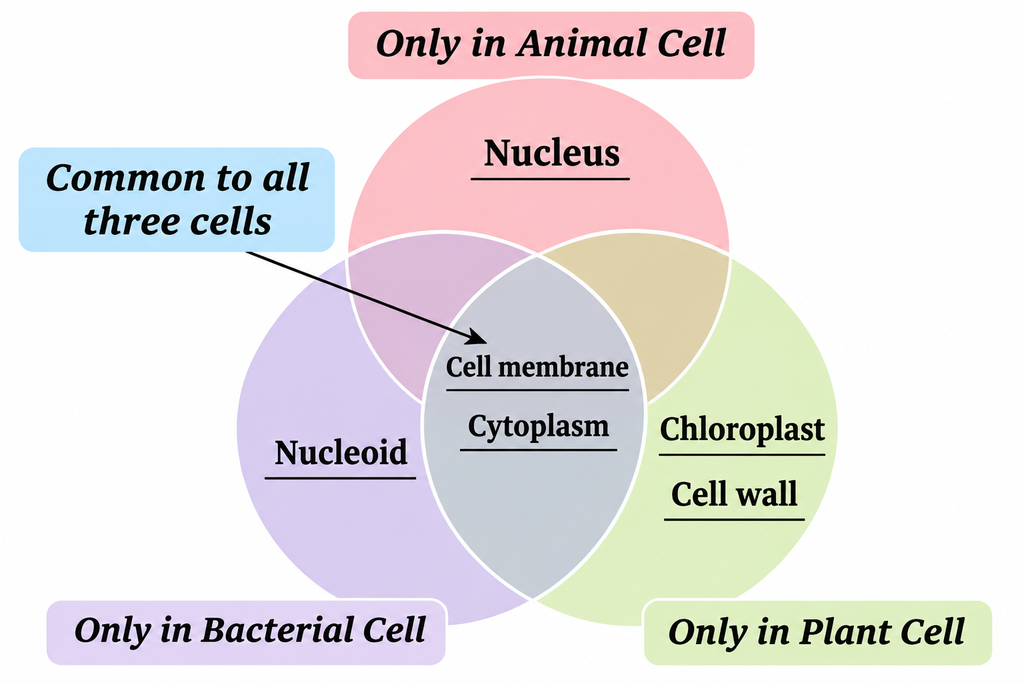
1. Various parts of a cell are given below. Write them in the appropriate places in the following diagram.
- Nucleus
- Cytoplasm
- Chloroplast
- Cell wall
- Cell membrane
- Nucleoid
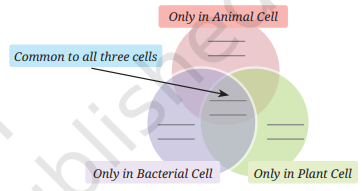
Ans:
2. Aanandi took two test tubes and marked them A and B. She put two spoonfuls of sugar solution in each of the test tubes. In test tube B, she added a spoonful of yeast. Then she attached two incompletely inflated balloons to the mouth of each test tube. She kept the set-up in a warm place, away from sunlight.
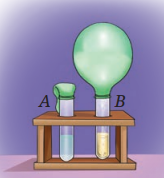
(i) What do you predict will happen after 3–4 hours? She observed that the balloon attached to test tube B was inflated. What can be a possible explanation for this?
(a) Water evaporated in test tube B and filled the balloon with the water vapour.
(b) The warm atmosphere expanded the air inside the test tube B, which inflated the balloon.
(c) Yeast produced a gas inside the test tube B which inflated the balloon.
(d) Sugar reacted with warm air, which produced gas, eventually inflating the balloon.
(ii) She took another test tube, 1/4 filled with lime water. She removed the balloon from test tube B in such a manner that the gas inside the balloon did not escape. She attached the balloon to the test tube with lime water and shook it well. What do you think she wants to find out?
Ans: (i) After 3–4 hours, the balloon attached to test tube B will inflate, while the balloon attached to test tube A will remain almost unchanged. This happens because yeast produces carbon dioxide gas by breaking down sugar.
Correct option: (c) Yeast produced a gas inside the test tube B which inflated the balloon.
Ans: (ii) She wants to find out whether the gas produced by yeast is carbon dioxide. If the lime water turns milky, it confirms the presence of carbon dioxide gas.
3. A farmer was planting wheat crops in his field. He added nitrogen-rich fertiliser to the soil to get a good yield of crops. In the neighbouring field, another farmer was growing bean crops, but she preferred not to add nitrogen fertiliser to get healthy crops. Can you think of the reasons?
Ans: Wheat plants require nitrogen-rich fertilisers for healthy growth and a good yield because they cannot directly use atmospheric nitrogen. On the other hand, bean plants are leguminous plants that have special bacteria called Rhizobium living in their root nodules. These bacteria trap nitrogen from the air and convert it into a form that plants can use. Therefore, bean plants do not require additional nitrogen fertilisers.
4. Snehal dug two pits, A and B, in her garden. In pit A, she put fruit and vegetable peels and mixed it with dried leaves. In pit B, she dumped the same kind of waste without mixing it with dried leaves. She covered both the pits with soil and observed after 3 weeks. What is she trying to test?
Ans: Ans: She is trying to test whether mixing dried leaves with fruit and vegetable peels helps in the decomposition of organic waste and the formation of manure.
5. Identify the following microorganisms:
(i) I live in every kind of environment, and inside your gut.
Ans: Bacteria.
(ii) I make bread and cakes soft and fluffy.
Ans: Yeast.
(iii) I live in the roots of pulse crops and provide nutrients for their growth.
Ans: Rhizobium.
6. Design an experiment to test that microorganisms need optimal temperature, air, and moisture for their growth.
Ans: To test that microorganisms need optimal temperature, air, and moisture for their growth, we can perform the following experiment:
Materials required: Three slices of bread, three clean plates, water and three transparent plastic bags.
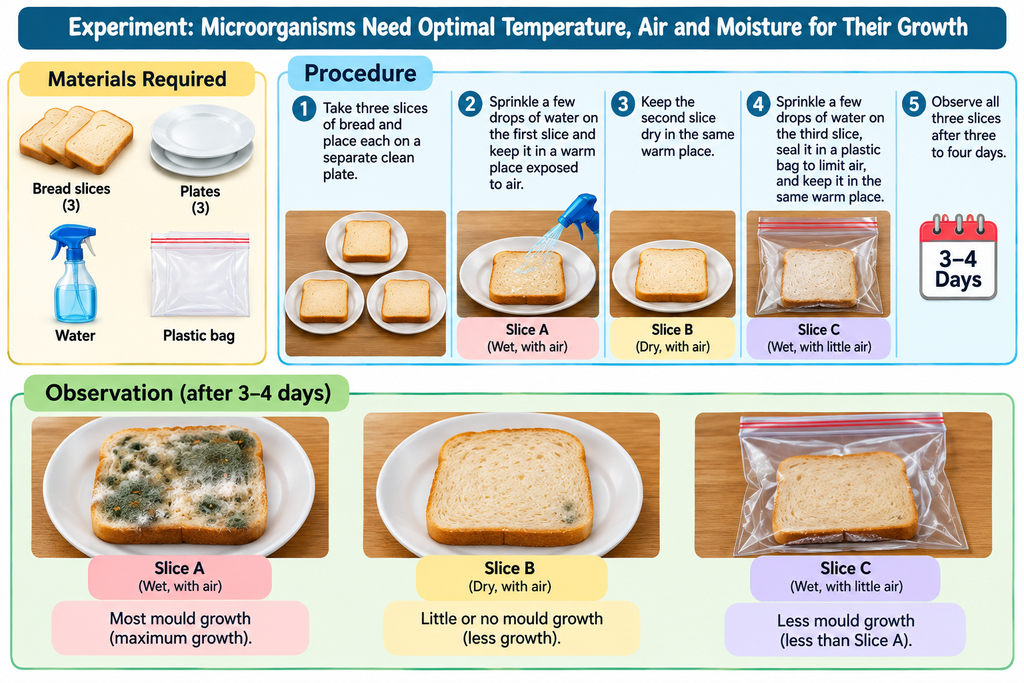
Conclusion: Microorganisms grow better when they get suitable temperature, air and moisture.
7. Take 2 slices of bread. Place one slice in a plate near the sink. Place the other slice in the refrigerator. Compare after three days. Note your observations. Give reasons for your observations.
Ans: Observation:
(i) The bread slice kept near the sink may develop mould growth after three days.
(ii) The bread slice kept in the refrigerator may show little or no mould growth.
Reason:
Microorganisms grow faster in warm and moist conditions. The bread kept near the sink gets suitable warmth and moisture, which help mould grow. The low temperature inside the refrigerator slows down the growth of microorganisms.
8. A student observes that when curd is left out for a day, it becomes more sour. What can be two possible explanations for this observation?
Ans: The two possible explanations are:
(i) Lactobacillus bacteria continue to grow and multiply in the curd when it is left outside.
(ii) These bacteria convert more milk sugar (lactose) into lactic acid, making the curd more sour.
9. Observe the set-up given in Fig. 2.15 and answer the following questions.
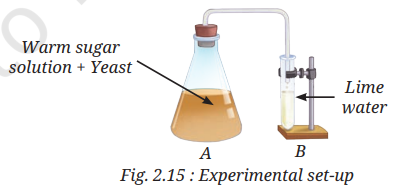
(i) What happens to the sugar solution in flask A?
Ans: The yeast ferments the sugar solution and produces carbon dioxide gas and a small amount of alcohol.
(i) What do you observe in test tube B after four hours? Why do you think this happened?
Ans: The lime water in test tube B turns milky because carbon dioxide gas released by yeast passes into it.
(iii) What would happen if yeast was not added in flask A?
Ans: If yeast was not added, fermentation would not take place. Therefore, carbon dioxide gas would not be produced, and the lime water would remain clear.
Conclusion:
NCERT Class 8 Science Chapter 2 The Invisible Living World: Beyond Our Naked Eye Textual Questions and Answers provide students with clear explanations of the chapter’s important concepts. By studying these answers and revising the key points, students can improve their understanding of the topic and prepare more effectively for their examinations.

Parimol Roy, BA graduate and HR professional at Dev Library, specializes in website content management and SEO for educational resources.
Subject Ka Complete Video Solution Dekhein
Step-by-step easy concept explanation aur full questions Answer ke liye watch karein ya app download karein:


 Buy Now