
Class 11 Physics Important Chapter 14 Oscillations Solutions English Medium As Per AHSEC New Syllabus to each chapter is provided in the list so that you can easily browse through different chapters NCERT Class 11 Physics Important Chapter 14 Oscillations and select need one. AHSEC Class 11 Physics Additional Notes English Medium Download PDF. HS 1st Year Physics Important Solutions in English.
Class 11 Physics Important Chapter 14 Oscillations
Also, you can read the NCERT book online in these sections Solutions by Expert Teachers as per Central Board of Secondary Education (CBSE) Book guidelines. NCERT Class 11 Physics Additional Question Answer are part of All Subject Solutions. Here we have given HS 1st Year Physics Important Notes in English for All Chapters, You can practice these here.
Oscillations
Chapter: 14
| IMPORTANT QUESTION AND ANSWER |
Answer the Following Questions:
1. What is simple harmonic motion (SHM)?
Ans: Simple harmonic motion is a type of oscillatory motion where the restoring force is directly proportional to the displacement from the equilibrium position and acts in the direction opposite to the displacement. The motion follows a sinusoidal pattern.
2. What is the relation between period and frequency of oscillatory motion?
Ans: The period (T) is the time taken for one complete cycle of the motion, and the frequency (ν) is the number of cycles per second. The relation is given by:
ν = 1/T
3. What is the total energy in simple harmonic motion?
Ans: The total mechanical energy (E) in SHM is the sum of kinetic energy (K) and potential energy (U). It is constant for a given oscillating system and is given by:
E = 1/2kA2
where A is the amplitude of the motion and k is the spring constant.
4. What is the role of restoring force in simple harmonic motion?
Ans: The restoring force is the force that acts towards the equilibrium position to bring the particle back. It is directly proportional to the displacement of the particle and always acts in the opposite direction.
The restoring force in SHM is given by:
F = −kx
where k is the spring constant and xxx is the displacement. This force is responsible for the oscillatory motion, ensuring that the particle oscillates back and forth around the equilibrium position.
5. What is the restoring force in simple harmonic motion?
Ans: The restoring force in simple harmonic motion is the force that always acts in the direction opposite to the displacement, trying to bring the particle back to its equilibrium position.
It is proportional to the displacement and is given by:
F(t) = −kx(t)
where x(t) is the displacement from the equilibrium position and k is the spring constant or the constant of proportionality. This force is responsible for maintaining the oscillatory motion.
6. Derive the expression for the velocity of a particle in simple harmonic motion.
Ans: The displacement of a particle in SHM is given by:
x(t) = Acos(ωt+ϕ)
To find the velocity, we differentiate the displacement with respect to time:
v(t) = d/td[Acos(ωt+ϕ)]
v(t) = −Aωsin(ωt+ϕ)
Thus, the velocity of a particle in SHM is:
v(t) = −ωAsin(ωt+ϕ)
where ω is the angular frequency, A is the amplitude, and ϕ is the phase constant.
7. What is angular frequency and how is it related to the frequency of oscillation?
Ans: Angular frequency (ω) is the rate at which an object moves through its oscillatory cycle in radians. It is related to the frequency of oscillation
(v) by the formula:
ω = 2πv
where:
ω is the angular frequency in radians per second,
v is the frequency in cycles per second (Hz).
Thus, the angular frequency gives the rate of change of the phase in radians per second, while frequency gives the number of complete oscillations per second.
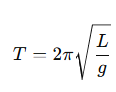
8. Derive the equation for the time period of a simple pendulum.
Ans: For a simple pendulum, the time period T (the time taken for one complete oscillation) is derived from the restoring force acting on the pendulum’s bob:
The restoring force is F = −mgsinθ, where mmm is the mass of the bob, g is the acceleration due to gravity, and θ\thetaθ is the angle of displacement.
For small displacements, sinθ≈θ (in radians).
Using Newton’s second law of motion and considering torque, we get:
Iα = −mgLθ
where L is the length of the pendulum and I = mL2 is the moment of inertia of the bob.
Solving for angular acceleration α, we get:
α = −Lgθ
This equation is of the form α=−ω2θ, which indicates simple harmonic motion with angular frequency ω = √g/L
The time period T is given by:
9. How is the energy of a simple harmonic oscillator conserved?
Ans: In a simple harmonic oscillator, the total mechanical energy (sum of kinetic and potential energy) is conserved if no external forces like friction are acting on the system. The energy oscillates between kinetic energy and potential energy as the object moves.
At the mean position, the kinetic energy is maximum, and the potential energy is zero.
At the extreme positions, the kinetic energy is zero, and the potential energy is maximum.
The total mechanical energy E is given by:

where A is the amplitude, and k is the spring constant. This total energy remains constant throughout the oscillation.
10. How do you calculate the amplitude of oscillation from energy?
Ans: The amplitude A of oscillation can be calculated from the total mechanical energy E of the system. Since the total energy in SHM is conserved, and it is the sum of kinetic and potential energy:

Rearranging this equation to solve for the amplitude:
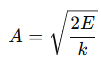
where E is the total energy, and k is the spring constant. This equation allows you to calculate the amplitude from the known energy of the system.

Hi, I’m Dev Kirtonia, Founder & CEO of Dev Library. A website that provides all SCERT, NCERT 3 to 12, and BA, B.com, B.Sc, and Computer Science with Post Graduate Notes & Suggestions, Novel, eBooks, Biography, Quotes, Study Materials, and more.
Subject Ka Complete Video Solution Dekhein
Step-by-step easy concept explanation aur full questions Answer ke liye watch karein ya app download karein:


 Buy Now